The 10-minute weekly review that keeps your goals alive
Most goals don't die from lack of effort — they die from lack of a check-in. Here's the simple weekly review I do in ten minutes, and the science that explains why it works.
For years my goals followed the same sad arc: a burst of motivation in January, a couple of strong weeks, and then silence. They didn't fail because I stopped caring or stopped working. They failed because nothing ever pulled me back to look at them. The fix turned out to be almost embarrassingly small — a ten-minute weekly review.
A weekly review is just a short, regular check-in with your own life: what happened, what mattered, and what's next. It's the hinge between your big goals and the days that are supposed to be moving you toward them. Without it, your week runs on autopilot and your goals quietly drift out of view.
Why a weekly review works (it's not willpower)
Reflection isn't a soft, optional extra — it measurably improves how you perform. In a well-known set of experiments, people who spent a few minutes reflecting on what they'd done scored 22.8% higher than those who simply kept working. The act of stepping back and naming what worked is what lets you do it better next time.
There's a second reason it works: monitoring. A large analysis of 138 studies found that the simple act of checking your progress reliably increases the odds you'll reach your goal — and the effect is stronger when you actually write that progress down. A weekly review is monitoring, made into a ritual.
The 10-minute weekly review, step by step
You don't need a complicated system. I do five quick passes:
1. Look back (3 minutes)
Skim your past week. What did you actually do? Don't judge it yet — just notice. Most people are shocked to see how much they accomplished once it's in front of them.
2. Name your wins (2 minutes)
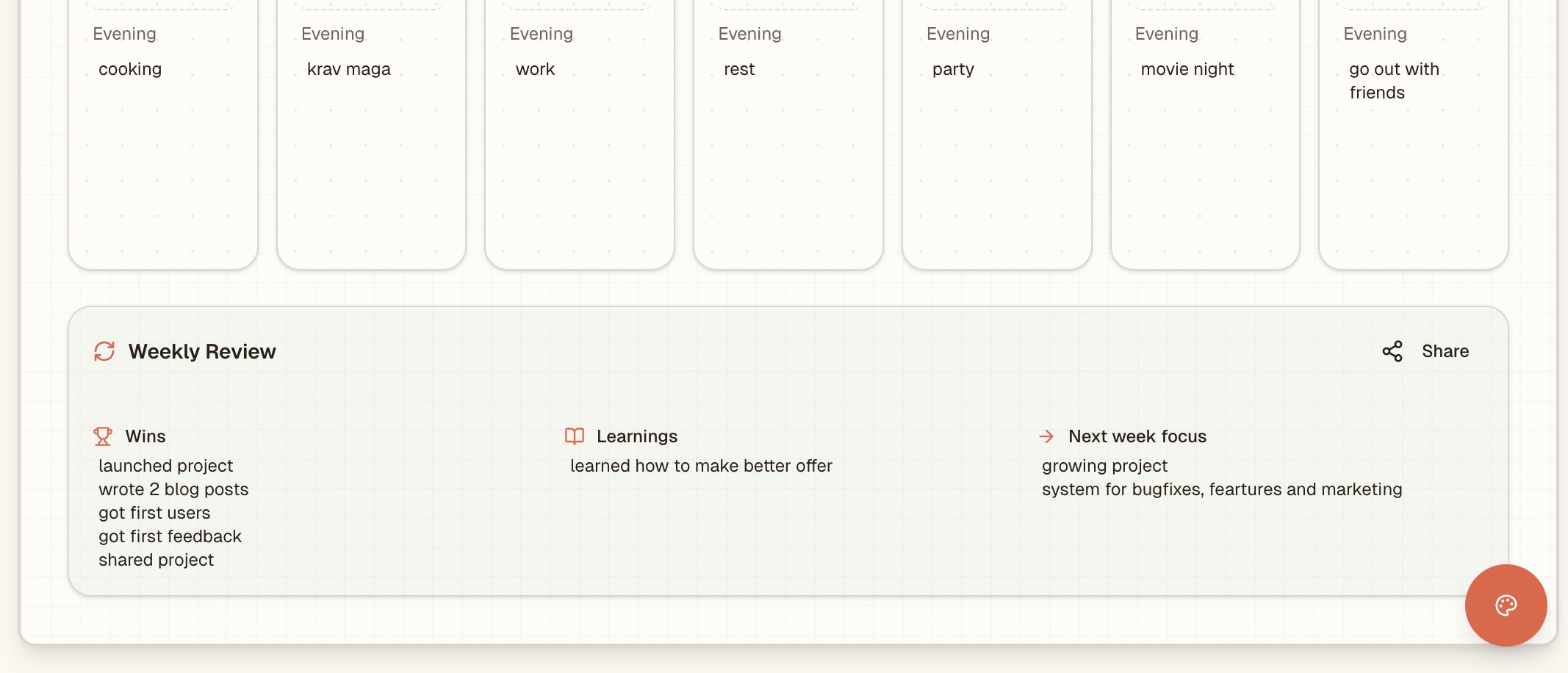
Write down two or three things that went well, however small. This isn't fluff — seeing progress is the single biggest driver of motivation, so naming your wins literally fuels next week.
3. Notice what got in the way (2 minutes)
What slowed you down? A recurring distraction, an over-packed schedule, a task you kept avoiding? You're looking for patterns, not reasons to feel bad.
4. Reconnect to your goals (1 minute)
Glance at your bigger goals. Did this week move any of them forward? If a week goes by with zero movement on what matters, that's the signal a weekly review exists to catch.
5. Choose next week's focus (2 minutes)
Pick the few things that would make next week a success, and make sure at least one of them points at a real goal. Decide roughly when they'll happen — deciding the when and where, not just the what, is one of the most reliable ways to actually follow through.
Make it a habit you'll keep
The best weekly review is the one you'll actually do, so make it easy and pleasant. Pick a consistent time — Sunday evening and Friday afternoon are both popular. Pair it with something you enjoy, like a coffee or a quiet corner. And keep the bar low: ten honest minutes beats an elaborate two-hour ritual you do twice and abandon.
In Planami, the weekly review is built in. Your week, your goals, and your wins are already in one place, so the reflection takes minutes instead of a setup project. It's the same calm review I do every week — just without the blank page.
Try it this Sunday. Ten minutes. Look back, name your wins, reconnect to your goals, and choose your focus. Do it for a month and watch how much longer your goals stay alive.
Sources
- Di Stefano, Gino, Pisano & Staats — "Learning by Thinking," Harvard Business School: read the paper
- Harkin et al. (2016) — Monitoring goal progress meta-analysis, Psychological Bulletin: overview
- Amabile & Kramer — "The Power of Small Wins," Harvard Business Review: read the article