What Your Mood Data Actually Tells You About How You Plan
Tracking your daily mood and stress levels in your planner isn't journaling fluff — it's the missing context that explains why some weeks feel manageable and others don't.
You know the week. Everything on paper looked fine — the tasks were reasonable, the calendar wasn't overloaded. But by Thursday you were running on empty, and you couldn't explain why. You just felt off. Then you had the same week three months later, and you still couldn't explain it. The pattern was there. You just didn't have the data to see it.
Mood tracking in a planner isn't about logging feelings for feelings' sake. It's about giving yourself the context that makes your planning decisions make sense in hindsight — and eventually, in advance.
The gap between what you planned and how you felt
Most planners track what you did. Checked tasks, completed goals, filled pages. That's useful, but it's only half the picture. The other half — how you felt while doing those things — goes unrecorded. And without it, you can't distinguish between a productive week that energized you and a productive week that depleted you. Both look the same in a task list.
When you add mood and stress data alongside your daily entries, the picture changes. You start to see that your most focused weeks often follow a quiet weekend. That the months you log the most stress are also the months your goals stall. That the evenings you skip your evening walk are reliably followed by lower-mood mornings.
These aren't revolutionary insights. They're obvious — once you can see them.
How Planami's wellness tracking works
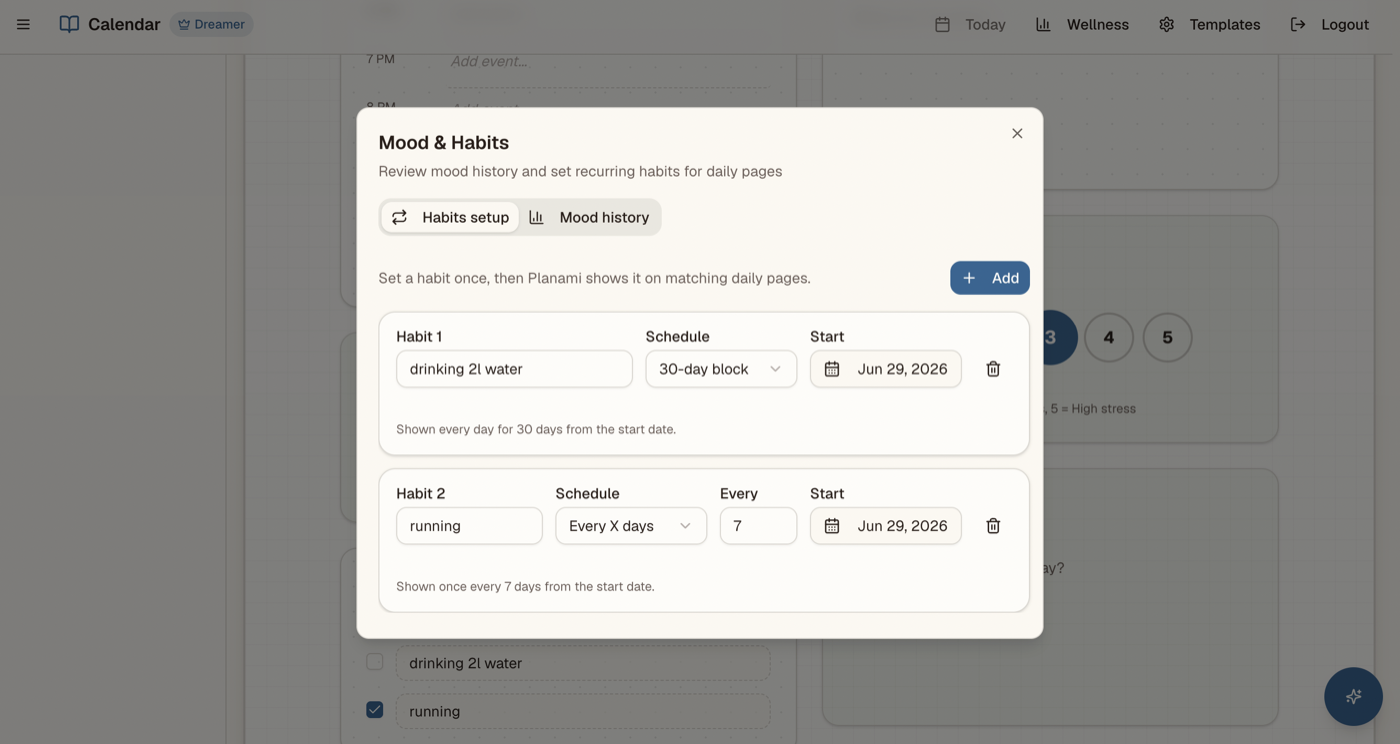
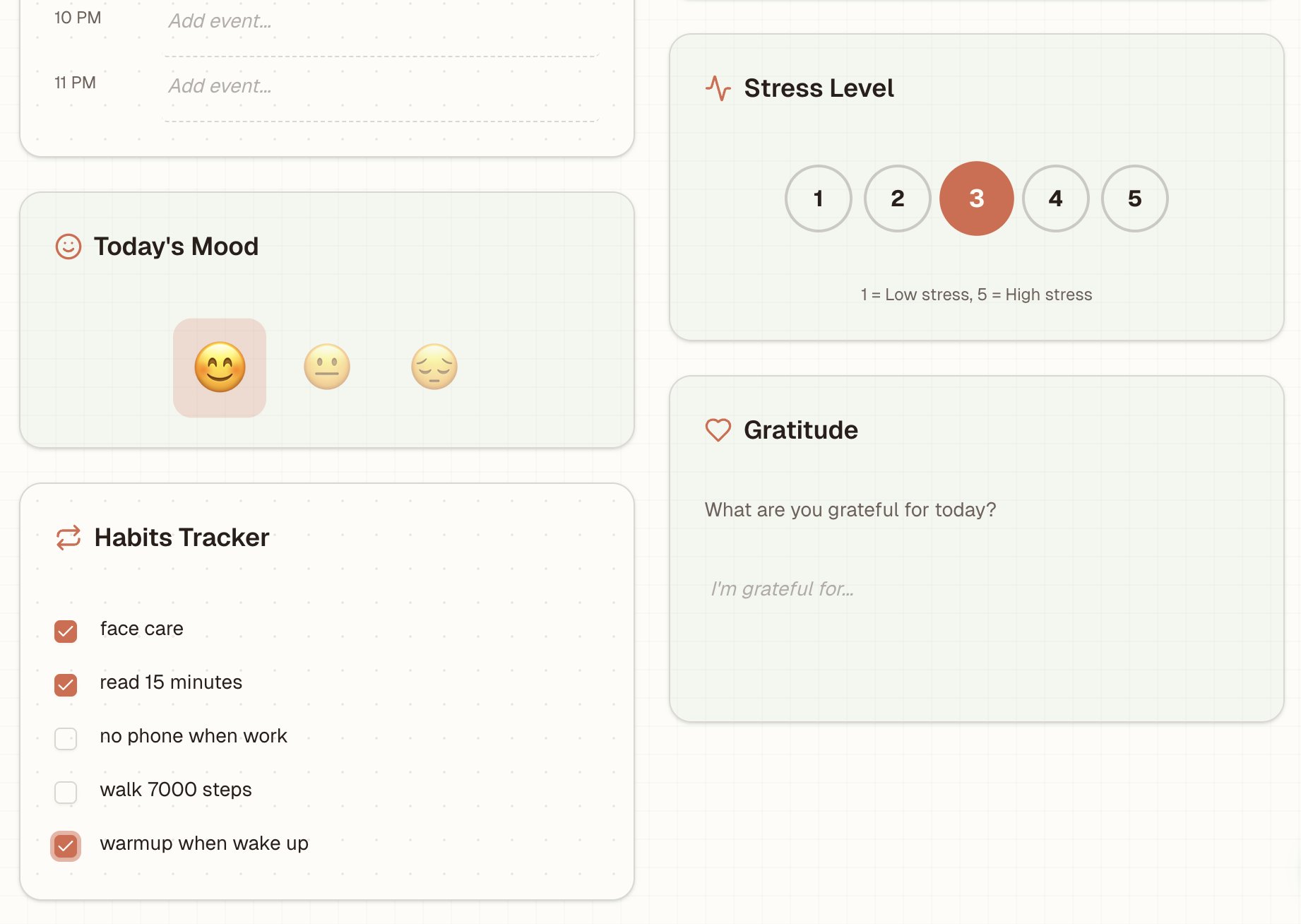
In Planami, mood and stress tracking live in the wellness settings alongside habit scheduling. Each day, you can log your mood from three options — calm and good, neutral, or low — and rate your stress on a 1 to 5 scale. That's the entire input. Two taps, ten seconds.
Planami then builds two views from this data:
The year mood map
A grid showing your dominant mood for each month, at a glance. You can see immediately which months felt heavier and which felt steadier. This is the kind of view that makes you stop and think — not in a anxious way, but in a "huh, April is always hard for me" way. That recognition is the first step toward planning around it instead of through it.
The year stress map
The same idea for stress: your average stress level per month, color-coded from green to red. When you can see that October and February consistently run hot, you can go into those months with more buffer built in rather than maxing out your commitments and wondering why you're struggling.
The difference between tracking and noticing
There's a version of self-tracking that makes anxiety worse. When you use data to judge yourself — when a low-mood day becomes evidence of failure, or a high-stress month becomes proof that something is wrong with you — the tracking itself becomes a source of pressure.
Planami's approach is designed to avoid that. The mood log uses broad categories by design: you're not rating your mood on a 10-point scale or analyzing emotional subtleties. You're making a quick, honest mark so that future-you has something to look at. The stress scale is a rough guide, not a performance metric. And neither feeds any kind of score, streak, or comparison.
The goal is noticing, not optimizing. Patterns that help you plan with more self-awareness, not another system to feel behind on.
What to actually do with your mood data
After a month of logging, look at your mood and stress history with one question: what do I want to protect?
Maybe you notice that low-mood days cluster around periods of poor sleep, or high-stress months follow overcommitment in the month before. Maybe you see that your mood is almost always good on weeks when you kept a habit going, and lower on weeks when the habit slipped.
Those observations don't need to become a productivity optimization plan. They just need to become inputs into how you plan the next month. More buffer here. A protected morning there. A habit that you know, from the data, genuinely helps.
That's the calm version of self-improvement: not pushing harder, but planning smarter — and being gentler with yourself when you understand the context.
Start with one data point
The easiest way to begin is to log just your mood at the end of each day — one quick selection in your daily planner page. Don't add stress tracking yet. Don't analyze anything. Just mark how the day felt, and move on.
After a few weeks, open the wellness settings and look at your mood history. You'll have more information than you think. And once you see what patterns are already there, you'll want to keep going.